Data-driven restaurant marketing uses your own sales, product and customer analytics to decide what to promote, when to run campaigns and which customers to target. This guide sets out 10 strategies across those three layers, from filling slow days and raising average order value to rescuing underperforming dishes and winning back regulars who have gone quiet. Because each campaign is built on real customer behaviour rather than assumptions, it is easier to measure and wastes less budget.
Key takeaways
- Sales analytics reveal slow days and peak hours, so you can run targeted offers when trade is quiet and message customers just before demand peaks.
- Raising average order value from £18 to £22 is a 22% revenue increase without a single new customer.
- Checkout messages, combo deals and loyalty nudges use product data to suggest the most popular add-ons at the moment of order.
- Give an underperforming dish a dedicated campaign before you cut it, because low sales are sometimes a visibility problem rather than a dish problem.
- Customer analytics show which regulars have gone quiet, and a single well-timed personalised message is often enough to bring them back.
- Knowing whether revenue comes from loyal regulars or new customers tells you whether to prioritise retention or turning first orders into second ones.
Most restaurants are sitting on a gold mine of data and don't know it.
Every order placed.
Every dish that sells — and every one that doesn't.
Every customer who comes back every Friday — and every one who disappeared after their first visit.
The restaurants growing right now aren't guessing what their customers want.
They're reading the data — and acting on it.
This guide covers 10 proven restaurant marketing strategies built entirely from your own analytics: sales data, product data, and customer data. No guesswork. No wasted budget. Just campaigns that work because they're built on what your customers are already doing.
Why Data-Driven Restaurant Marketing Works
Traditional restaurant marketing is broad.
A discount post on Instagram. A flyer. A generic email blast to everyone on your list.
It might generate a few orders — but it's expensive, hard to measure, and easy to ignore.
Data-driven restaurant marketing is the opposite.
It targets the right customer, with the right offer, at the right moment.
And because it's based on real behaviour — not assumptions — it converts.
The three layers of restaurant analytics that make this possible:
- Sales Analytics — order volume, average order value, total sales
- Product Analytics — best sellers, underperformers, featured items
- Customer Analytics — order frequency, favourite dishes, loyalty tier, last visit
Here's how to turn each one into a marketing strategy that drives real results.
Sales Analytics: 3 Strategies to Grow Revenue
1. Find Your Slow Days — and Kill Them With a Campaign
Your sales data will almost always reveal a pattern.
A slow Tuesday. A dead Sunday afternoon. A drop-off after 9pm.
Most restaurant owners accept this as normal.
Smart ones turn it into an opportunity.
Once you identify your lowest-performing time slots, build a campaign specifically around them:
- A "Tuesday special" with a limited-time discount
- A push notification at 5pm on your slowest day: "Tonight only — free dessert with every order"
- An SMS campaign to loyal customers: "We've got a quiet table with your name on it this Sunday"
Turning a slow day into a targeted campaign is one of the highest-ROI moves in restaurant marketing.
You already have the customers. You just need to give them a reason to show up.
2. Boost Average Order Value With Smarter Upselling
Average order value (AOV) is one of the most powerful levers in restaurant marketing — and one of the most overlooked.
If your AOV is £18 and you can move it to £22, that's a 22% revenue increase without a single new customer.
Your sales analytics will show you where the gap is.
From there, you have several ways to close it:
- Checkout messages — surface your best add-ons at the moment of order
- Combo deals — bundle a starter or drink with main dishes
- Loyalty nudges — "Add £3 more to unlock double points"
Small increases in AOV, multiplied across hundreds of orders a month, compound fast.
3. Time Your Campaigns Around Peak Demand
Your order volume data tells you exactly when customers are most active.
That's when your marketing should be loudest.
If Friday evenings are your busiest window, don't send your push notifications on Thursday morning.
Send them Friday at 4pm — just as people are starting to think about dinner.
Timing is one of the simplest optimisations in restaurant marketing, and one of the most impactful.
Let your sales data set the schedule.
Product Analytics: 4 Strategies to Sell More of What Works
4. Turn Your Best-Selling Dish Into a Marketing Asset
Your top-selling dish is already proven.
Customers love it. They order it on repeat. It sells itself.
Now make it the hero of your marketing.
Feature it in your social media content.
Lead with it in your email campaigns.
Use it as the centrepiece of your next promotion.
Restaurants that build campaigns around their proven bestsellers consistently outperform those pushing new or untested items.
Your data already knows what people want — lead with that.
5. Rescue Underperforming Dishes Before You Cut Them
Before you remove a dish from your menu, give it a proper chance.
Product analytics will flag the items with low order frequency — the dishes that sit there quietly while everything else moves.
But low performance isn't always about the dish itself.
Sometimes it's about visibility.
Run a dedicated campaign before you cut anything:
- A social media post spotlighting the dish with great photography
- A limited-time discount to drive trial orders
- A push notification to customers who've never ordered it
If the campaign moves the needle, you've saved a dish and found a new revenue stream.
If it doesn't, you cut it with confidence — knowing you gave it every chance.
6. Use Checkout Messages to Guide Every Order
The checkout moment is the most valuable marketing real estate you have.
A customer has already decided to order.
They're engaged, they're spending, and they're open to suggestions.
Product analytics tells you which dishes pair well, which add-ons are most popular, and which items push order value higher.
Use that to power your checkout messages:
"Customers who ordered this also loved..."
"Add garlic bread for £2.50"
"You're £4 away from free delivery"
These micro-moments drive meaningful increases in average order value without any additional marketing spend.
7. Build Social Media Content Around What's Actually Selling
One of the biggest mistakes restaurants make on social media is posting randomly — whatever looks good that day.
Product analytics gives you a smarter approach.
Your best sellers should dominate your content calendar.
Your seasonal specials should get a campaign before they launch, not after.
Your underperformers should get a spotlight moment before they're retired.
When your social content is aligned with your actual sales data, every post has a purpose — and a measurable outcome.
Customer Analytics: 3 Strategies to Build Real Loyalty
8. Win Back Customers Who've Gone Quiet
This is one of the highest-value campaigns any restaurant can run.
Your customer analytics will show you exactly which regulars haven't ordered in a while — customers who used to come every week but haven't been seen in three weeks, four weeks, a month.
These aren't lost customers. They're distracted ones.
A single well-timed message is often enough to bring them back:
- A personalised push: "We miss you, [Name]. Here's 10% off your next order"
- An email featuring their favourite dish: "Your usual is waiting"
- A loyalty nudge: "You're only 50 points away from a free [item]"
The restaurants using this strategy see consistent lifts in monthly order frequency — because they're not just waiting for customers to come back. They're going to get them.
9. Personalise Offers Around Individual Behaviour
Generic discounts are forgettable.
Personalised offers feel like a conversation.
Customer analytics tells you what each person orders, how often, and what they love.
Use that to make your marketing feel human.
- A birthday discount on their favourite dish — not a generic voucher, their dish
- A reward tied to a milestone: "You've ordered 10 times — here's something on us"
- A "you might also like" campaign based on their order history
This level of personalisation used to require enterprise-level marketing budgets.
With the right system, any restaurant can do it — and customers notice.
10. Understand Where Your Revenue Is Really Coming From
This is the strategic question that changes everything:
Is your revenue driven by loyal regulars — or by a constant stream of new customers who don't come back?
Both patterns look fine on a total sales report.
But they require completely different marketing strategies.
If 80% of your revenue comes from 20% of loyal customers, protect them ferociously.
Double down on loyalty rewards, VIP perks, and personalised retention campaigns.
If you're heavily dependent on new customers, your priority shifts to conversion.
Turn that first order into a second one — fast — with a follow-up offer, an onboarding message, or a loyalty invite.
Customer analytics gives you this answer clearly.
And once you know it, your entire marketing strategy gets sharper.
Bringing It All Together: Data + Marketing in One Place
The strategies above only work if your analytics connect directly to your marketing tools.
That's the gap most platforms leave open — they give you the data, then leave you to figure out what to do with it.
Order Tiger closes that gap.
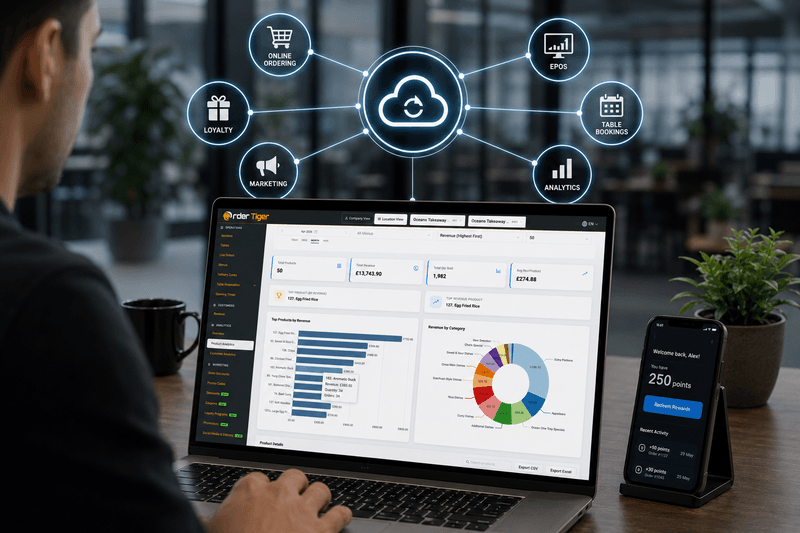
Sales analytics, product analytics, and customer analytics all live in one dashboard — and connect directly to email campaigns, push notifications, SMS, loyalty rewards, and social media content.
Restaurants using Order Tiger's Marketing Accelerator work with our team to build campaigns directly from their own data — and the results speak for themselves: higher repeat order rates, stronger loyalty engagement, and average order values that move in the right direction.
Because the data was always there.
The difference is knowing what to do with it.
Frequently asked questions
What is data-driven restaurant marketing?
Data-driven restaurant marketing builds campaigns from your own sales, product and customer analytics instead of broad promotions sent to everyone. It targets the right customer with the right offer at the right moment, so it is cheaper to run, easier to measure and harder to ignore than a generic flyer, discount post or email blast.
Which restaurant data should I use for marketing?
Use three layers. Sales analytics cover order volume, average order value and total sales. Product analytics show best sellers, underperformers and featured items. Customer analytics reveal order frequency, favourite dishes, loyalty tier and last visit. Together they tell you what to promote, when to send campaigns and which customers need attention.
How can a restaurant win back customers who stopped ordering?
Use customer analytics to find regulars who used to order every week but have not been seen for three weeks, four weeks or a month. Then send one well-timed message: a personalised push with 10% off the next order, an email featuring their favourite dish, or a loyalty nudge showing how close they are to a free item.
How do I increase average order value with my data?
Use product analytics to see which dishes pair well and which add-ons are most popular, then surface them in checkout messages, such as adding garlic bread for £2.50 or showing a customer they are £4 away from free delivery. Combo deals and loyalty nudges help too, and small increases across hundreds of orders a month compound fast.
How does Order Tiger help restaurants market with their own data?
Order Tiger keeps sales, product and customer analytics in one dashboard and connects them directly to email campaigns, push notifications, SMS, loyalty rewards and social media content. Restaurants on the Marketing Accelerator work with the Order Tiger team to build campaigns from their own data, aiming for higher repeat order rates, stronger loyalty engagement and a rising average order value.