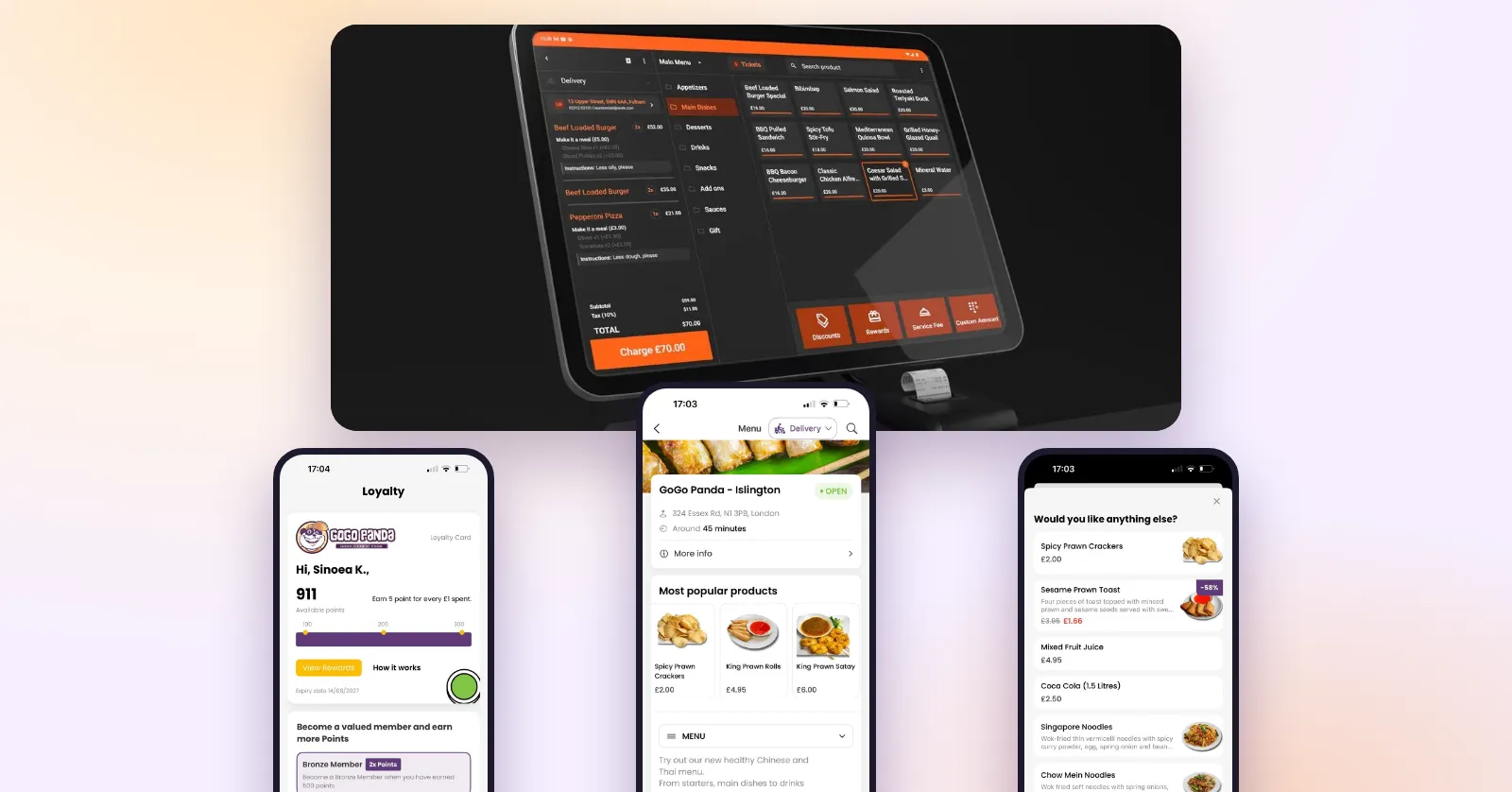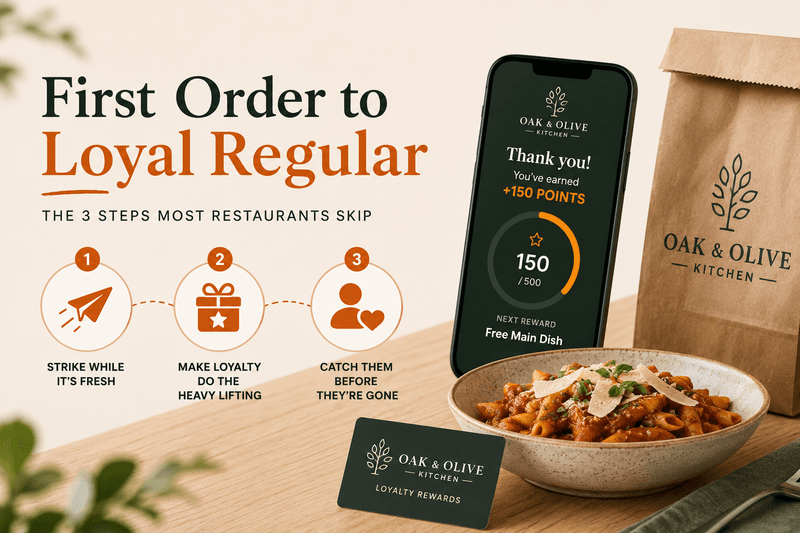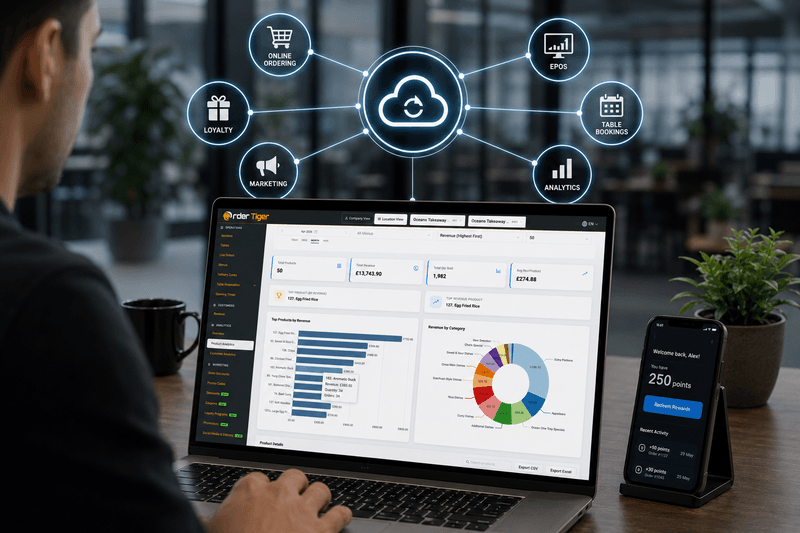
A restaurant loyalty programme drives online ordering sales because members visit 20% more often, spend 20% more per visit and are less likely to switch to a competitor. Restaurants that build loyalty into their digital ordering channels report an 18 to 28% increase in order frequency. The most effective programmes combine points or stamps with configurable earning rules, boosters and tiers, and Order Tiger builds all of them directly into your ordering website and apps.
Key takeaways
- Around 71% of quick-service and 68% of full-service restaurants already offer a loyalty scheme, with adoption expected to reach 80% by the end of 2026.
- Research from Bain and Company found that a 5% improvement in customer retention can increase profits by 25 to 95%.
- Stamps-based programmes drive order frequency, while points-based programmes, such as 10 points per £1 spent, encourage higher average order values.
- Boosters such as Triple Tuesdays, birthday bonuses or a 5pm to 8pm Happy Hour temporarily multiply earnings and can be stacked.
- Tiers such as Bronze 2×, Silver 3× and Gold 4× multiply earnings, so a Gold member’s £50 order on a double-points Friday earns 4,000 points.
- Make the first reward reachable within two or three purchases, keep earning rules simple and enrol online customers automatically.
How Restaurant Loyalty Programs Drive Online Ordering Sales
The Complete Guide for 2026
Retaining customers costs a fraction of acquiring new ones — and the right loyalty program can boost your restaurant’s profits by up to 25% - 95%. Here’s how to make it happen with your online ordering platform.
The restaurant industry surpassed $1 trillion in sales in 2024, and the pace is only accelerating. But in an increasingly crowded market — with over 700,000 chain locations in the US alone and countless independents competing for every order — great food alone isn’t enough. The restaurants pulling ahead are the ones turning first-time online customers into lifelong regulars through smart, well-structured loyalty programs.
If you’re running an online ordering operation and don’t yet have a loyalty programme in place, you’re almost certainly leaving money on the table. And if you do have one, there’s a good chance it could be working harder for you.
Why Loyalty Programs Are No Longer Optional
The numbers paint a clear picture. Around 71% of quick-service restaurants and 68% of full-service establishments now offer some form of loyalty scheme, with adoption expected to reach 80% by the end of 2026. Customer participation is rising in lockstep — nearly half of all restaurant customers are enrolled in at least one loyalty programme, and 81% of those who don't say they’d join one if it were offered at a favourite restaurant.
For online ordering specifically, the impact is even more pronounced. Restaurants with loyalty programs integrated into their digital ordering channels report an 18–28% increase in order frequency. Loyalty members visit 20% more often, spend 20% more per visit, and are significantly less likely to churn to a competitor. Research from Bain & Company found that a modest 5% improvement in customer retention can translate to a 25–95% increase in profits.
Perhaps most telling: 61% of restaurant customers say a loyalty program is an important factor when choosing where to place a delivery order. In the age of online ordering, loyalty isn’t just a nice perk — it’s a deciding factor.
20% more visits — Loyalty members order more frequently than non-members
20% higher spend — Enrolled customers spend more per transaction
81% would join — Consumers say they’d enrol in a loyalty programme if one were offered
61% say it matters — Delivery customers consider loyalty when choosing where to order
25–95% profit boost — From just a 5% improvement in customer retention
The Real Business Benefits of a Restaurant Loyalty Programme
Higher Order Frequency and Average Spend
Loyalty program members don’t just order more often — they spend more when they do. Studies consistently show that enrolled customers increase their spending per transaction by 6–15% compared to non-members, with premium tier members spending up to 18% more. 64% of loyalty program members spend more per transaction to maximise point earnings. When you combine that with a 20% lift in visit frequency, the compound effect on revenue is substantial.
Dramatically Improved Customer Retention
Acquiring a new customer costs five to twenty-five times more than keeping an existing one. A well-designed loyalty programme gives customers a tangible reason to come back, reducing the churn that silently drains restaurant margins. Restaurants with established programmes report 20% higher retention rates, and some operators have seen loyalty members return six to ten times more frequently than non-members.
Predictable, Stable Revenue
When a significant portion of your customer base is enrolled in a loyalty programme and actively earning rewards, your revenue becomes less volatile. Major brands generate over 50% of their revenue from loyalty members alone, creating a predictable income stream that buffers against seasonal slowdowns and market fluctuations.
First-Party Customer Data and Insights
Every loyalty interaction is a data point. You learn what your customers order, when they order, how much they spend, and how they respond to promotions. This intelligence lets you make smarter decisions about menu development, pricing, staffing, and marketing — all without relying on expensive third-party research.
Lower Marketing Costs and Competitive Differentiation
Direct communication with loyalty members through push notifications, email, and SMS is dramatically cheaper than paid advertising or third-party marketplace commissions. You own the relationship and the channel, meaning every promotional pound goes further. With nearly half of all restaurant customers actively using loyalty programmes, not having one puts you at a tangible disadvantage — 78% of loyalty users say they’re willing to go out of their way to visit a restaurant where they can earn rewards, even if it’s less convenient.
How Modern Loyalty Programs Work: Points, Stamps, and Beyond
The best loyalty programmes today go far beyond simple punch cards. They use layered mechanics that create multiple touchpoints for engagement, reward different types of customer behaviour, and scale with your business. Here’s how Order Tiger’s enterprise loyalty platform brings these mechanics together.
Stamps-Based Programmes
Stamps-based programmes award a fixed stamp for each qualifying order, regardless of the order total (provided it meets a minimum threshold). For instance, a customer earns 1 stamp for every order over £10. After collecting 10 stamps, they receive a reward. This model excels at driving order frequency, since the fastest way to fill a stamp card is to order more often.
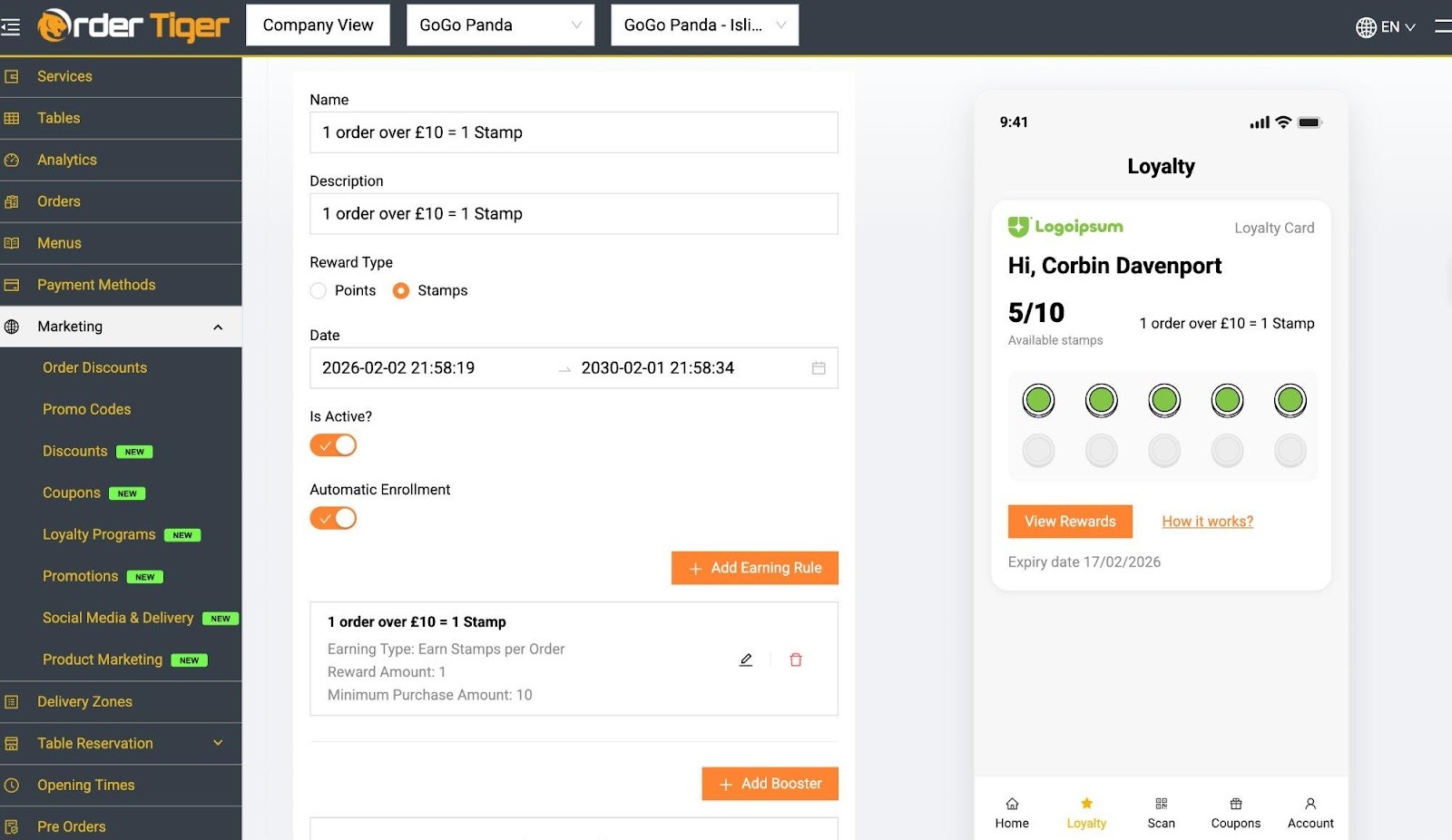
The admin dashboard for configuring a stamps-based loyalty programme — set earning rules, date ranges, and automatic enrolment.
On the customer side, the stamps experience is intuitive and engaging. Customers can see exactly how stamps are earned, track their progress on a visual stamp card, reach “Boosted Status” for enhanced earning, and even save their loyalty card to Apple Wallet for in-store use.
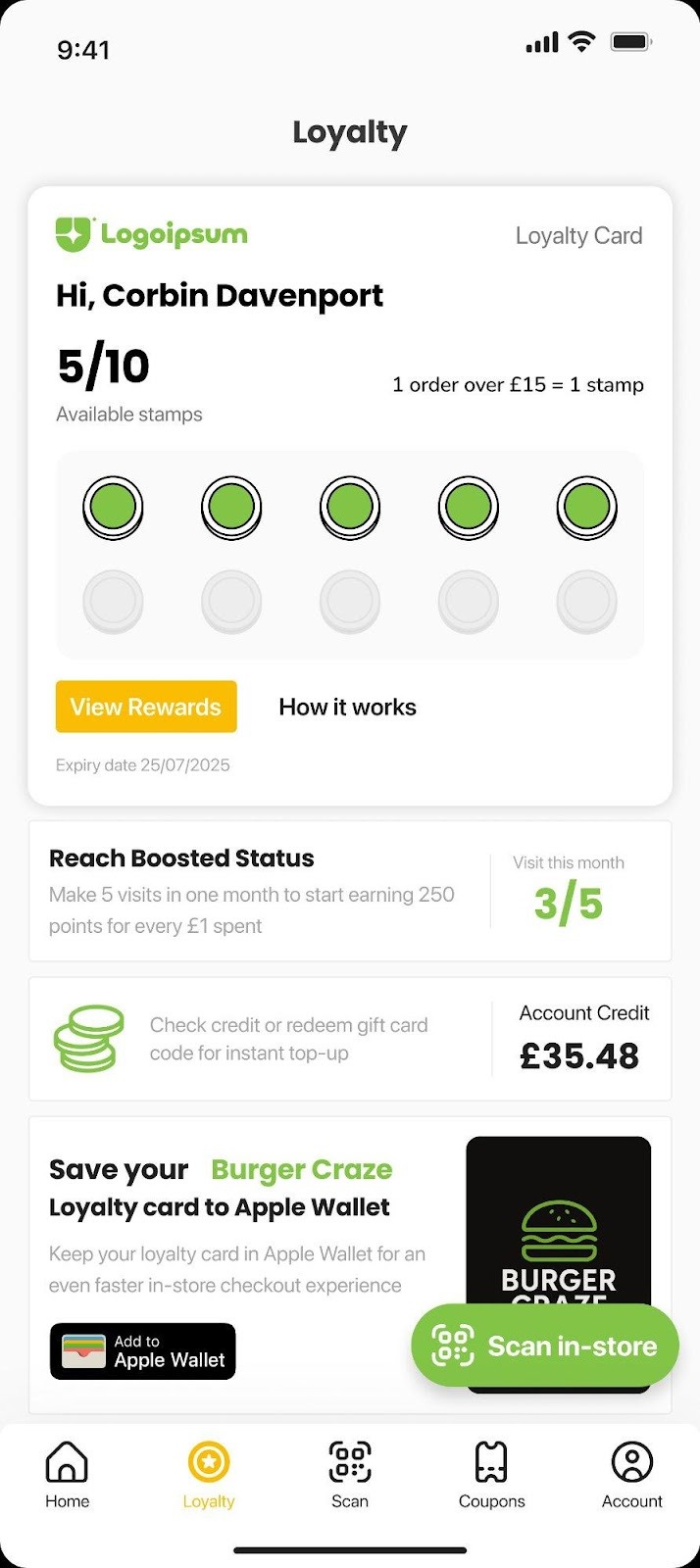
How stamps work — clear earning rules
Digital stamp card with Boosted Status
Points-Based Programmes
Points-based programmes award customers a set number of points relative to their spending. For example, a customer might earn 10 points for every £1.00 spent on their order. Points accumulate over time and can be redeemed for rewards at various thresholds — free items, percentage discounts, or free delivery. This model is ideal for encouraging higher average order values, since customers earn more by spending more.
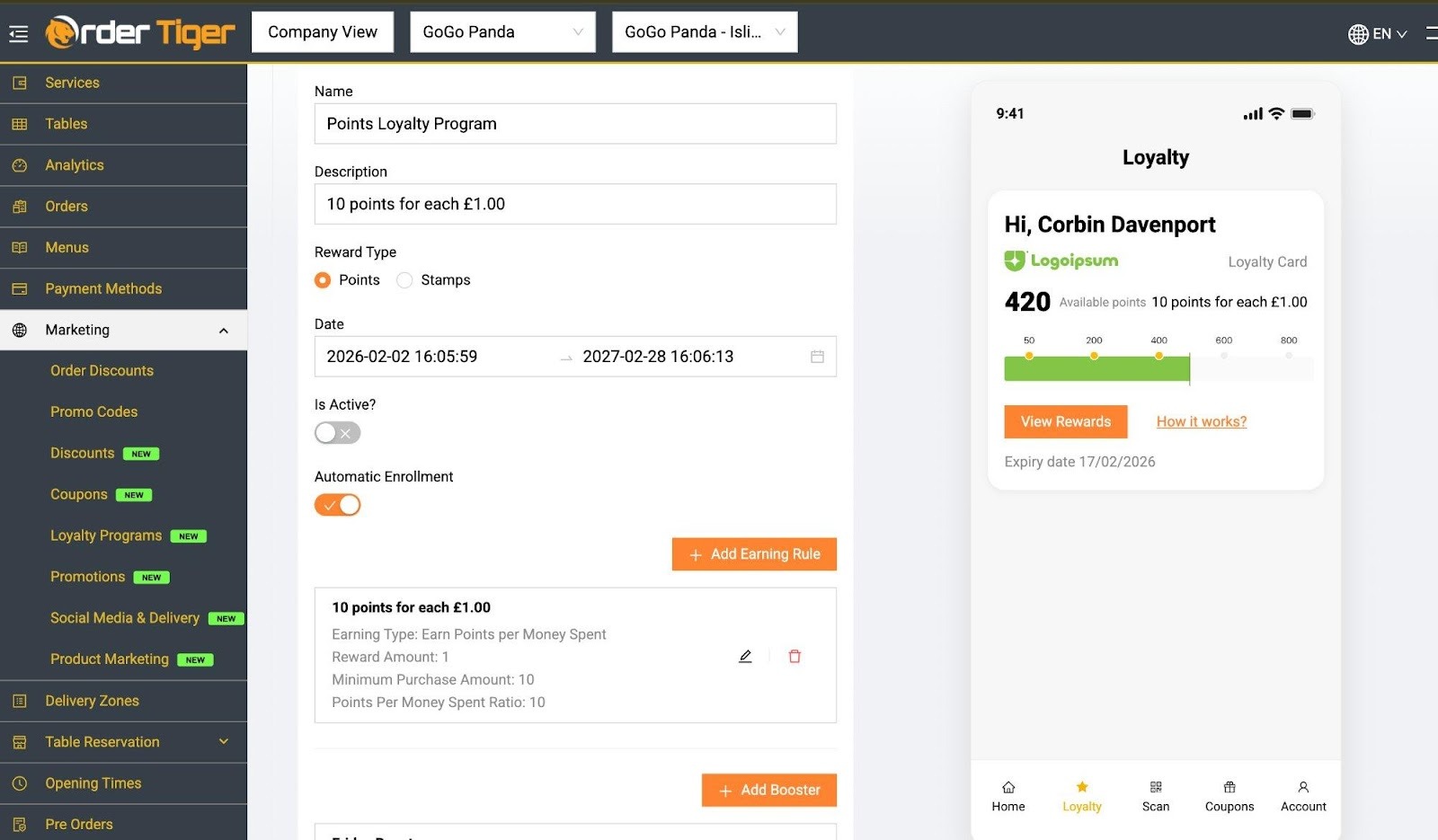
Configuring a points-based loyalty programme — 10 points per £1.00 spent, with a progress bar on the mobile preview.
Customers browse their available rewards and see exactly what they can redeem at each point threshold. The Rewards & Offers screen shows free items unlocked at 200, 300, and 1,000 points, plus discount offers like 15% off or free delivery. The Point Boost tab shows all active multipliers — Triple Tuesdays, Happy Hour, weekend and birthday bonuses — giving customers clear reasons to order at the right time.
Rewards: redeem points for free items & discounts
Point Boosts: multipliers that drive repeat orders
Both models are effective — the right choice depends on whether your primary goal is increasing basket size (points) or increasing order frequency (stamps).
Earning Rules: The Foundation
Earning rules define exactly how customers accumulate their points or stamps. These are fully configurable and might include rules such as “earn 2 points per £1 spent” or “earn 1 stamp per order with a minimum spend of £15.” Multiple earning rules can operate simultaneously within the same programme, giving you granular control over how rewards are distributed.
Points Visibility Throughout the Ordering Journey
One of the most powerful drivers of loyalty engagement is making points visible at every step of the ordering journey. With Order Tiger, customers see exactly how many points they’ll collect directly on the menu and when adding items to their basket. A “Collect 320 points” message on the item screen, or a “Spend £25, save £5” banner on the menu, creates constant positive reinforcement that encourages larger baskets and more frequent orders.
Points displayed at item level: “Collect 320 points”
Menu banner: promotional offers drive larger orders
Boosters: Targeted Multipliers
Boosters are conditional multipliers that temporarily increase the rate at which customers earn rewards. They’re powerful tools for shaping customer behaviour and driving orders during specific periods or from specific customer segments.
A booster might double points earned on orders placed on Fridays, offer Triple Tuesdays to drive midweek orders, award 5× points on a customer’s birthday, or activate a 2× Happy Hour multiplier between 5pm and 8pm. Boosters can be stacked — if a customer qualifies for multiple boosters simultaneously, the multipliers compound, creating exciting earning opportunities that generate buzz and urgency.
Tier Programmes: Rewarding Your Best Customers
Tier programmes add a status layer to your loyalty scheme. As customers accumulate points or stamps over their lifetime, they progress through membership tiers — Bronze, Silver, Gold, Platinum — or whatever naming convention suits your brand.
Each tier carries its own earning multiplier. A Bronze member might earn at 2× the standard rate, a Silver member at 3×, and a Gold member at 4×. This creates a powerful flywheel: the more a customer orders, the faster they earn, which motivates them to order even more to maintain or advance their status.
Tier programmes tap into deep psychological drivers. The sense of progression and achievement triggers dopamine responses that make the experience inherently rewarding. Status recognition builds an emotional connection to your brand that goes beyond transactional discounts.
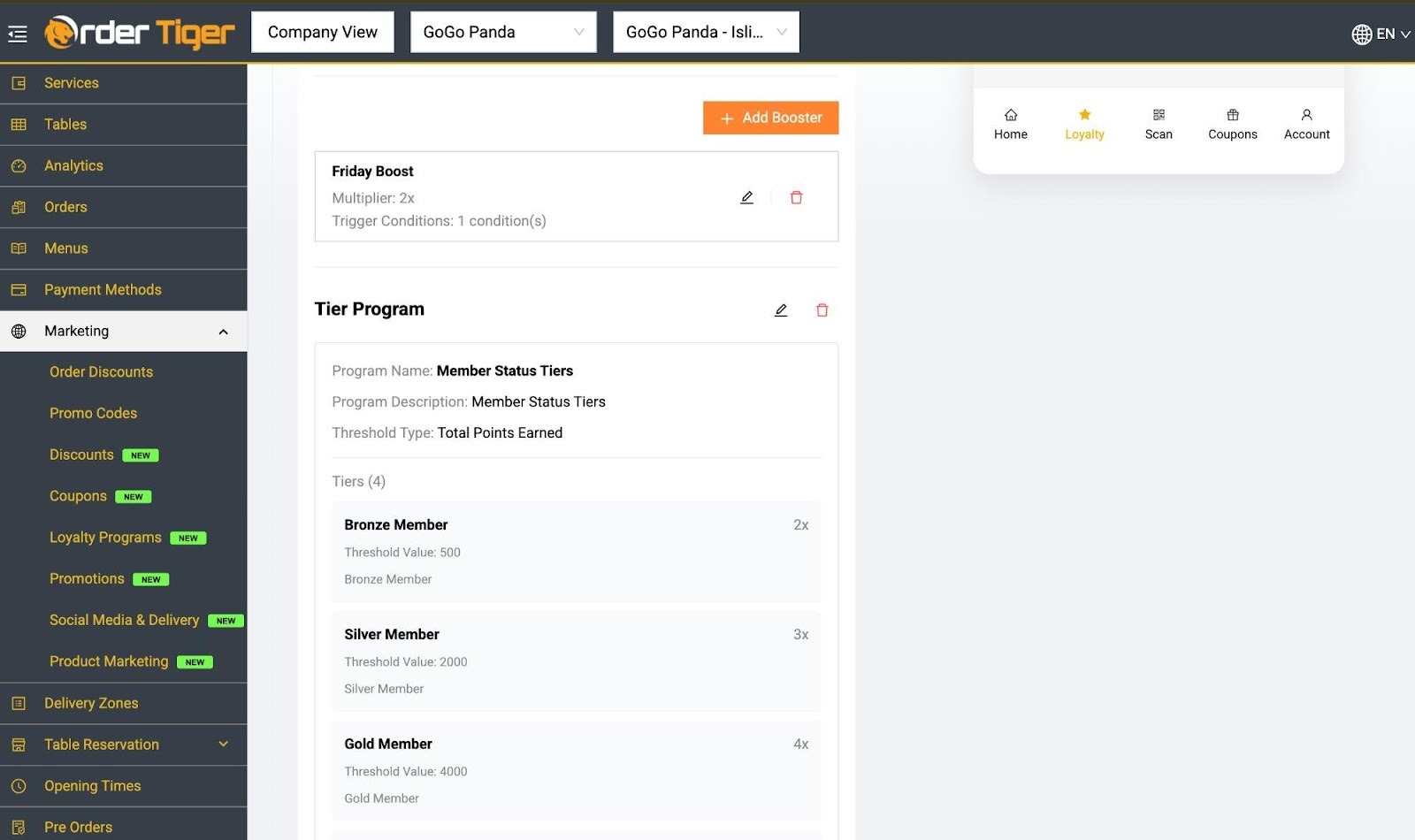
Boosters (e.g. Friday 2× Boost) and Tier Programmes (Bronze 2×, Silver 3×, Gold 4×) configured in the admin dashboard.
How It All Works Together
The real power of an advanced loyalty system lies in how these components interact. The calculation follows a multiplicative formula:
Total Earnings = (Earning Rules + Earning Rules N) × (Boosters) × (Tier Multiplier)
Example: A Gold-tier customer places a £50 order on a Friday. Their base earning rule awards 10 points per £1 spent (500 points). A Friday Booster doubles that (×2). Their Gold tier multiplies earnings by 4×. The result: 500 × 2 × 4 = 4,000 points from a single order. Compare that to the 500 points a non-tier member would earn on a regular day.
This layered approach means your loyalty programme isn’t a one-size-fits-all discount. It’s a dynamic, responsive system that rewards your best customers proportionally while giving newer customers a clear and exciting path to greater benefits.
Coupons & Promotions: Drive Sales with Targeted Offers
Beyond loyalty, Order Tiger’s promotions engine lets you create targeted discount offers and coupons that reward your loyal customers and attract new ones. You can set promotions that activate based on points or stamps thresholds — for example, offering £5 off orders over £25 once a customer has earned 1,250 points.
Promotions can be configured with precise conditions including minimum purchase amounts, valid date ranges, applicable service types (delivery, pick-up, catering, eat-in), accepted payment methods, and platform targeting (web, iOS, Android). This level of control ensures your promotional spend is directed exactly where it will have the most impact.
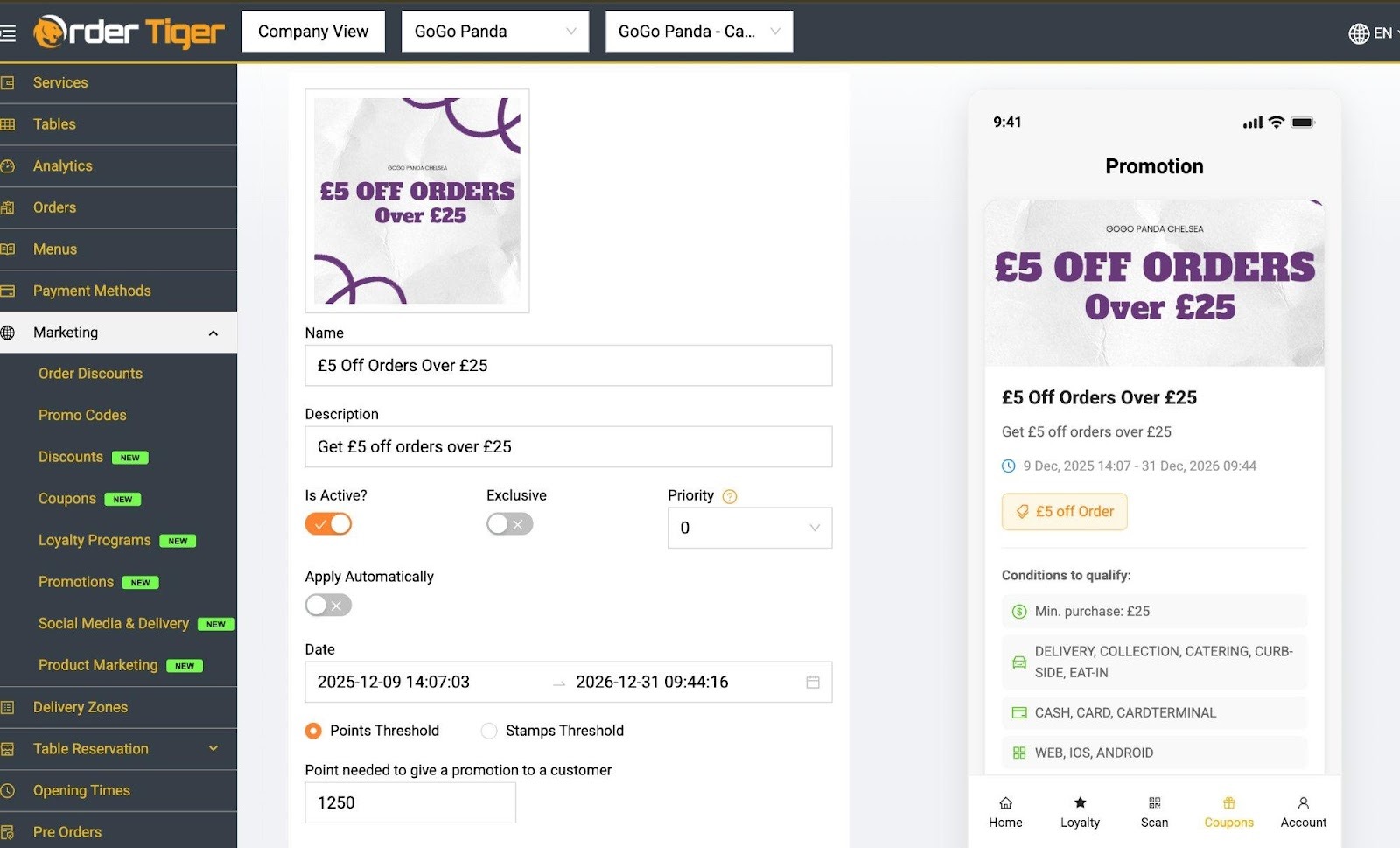
Admin configuration for promotions — set point thresholds, qualifying conditions, and date ranges.
Digital Coupons Your Customers Will Love
Order Tiger’s coupon system goes beyond simple promo codes. Customers browse a visually rich coupons gallery featuring eye-catching graphics for each offer — from special percentage discounts and free delivery Fridays to seasonal promotions like Mother’s Day deals and buy-one-get-one offers. Each coupon includes a clear code, description, and terms, and can be added to the order with a single tap.
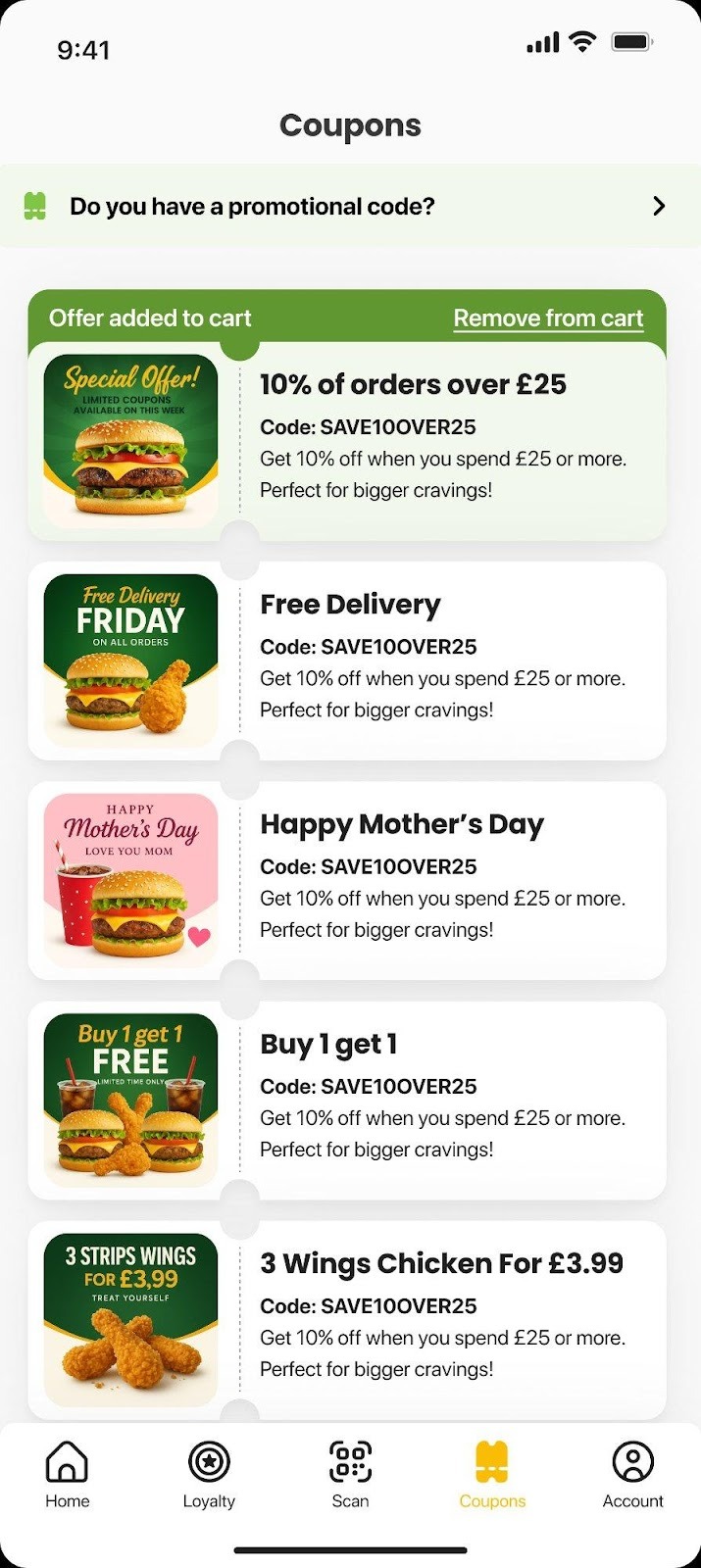
Browse all available coupons — tap to add to cart
Coupon details with terms & one-tap “Add to order”
This visual, self-service approach to coupons drives higher redemption rates than traditional promo codes alone. Customers discover offers they didn’t know about, increasing average order values and giving you a powerful channel for promoting seasonal campaigns, new menu items, and slow-day specials.
What to Look For in a Loyalty Platform
Not all loyalty solutions are created equal. Many tools marketed to restaurants offer little more than a basic digital punch card with rigid rules and limited customisation. If you’re serious about using loyalty to grow your online ordering revenue, here’s what matters:
Flexibility in reward models. You need the ability to run points-based programmes, stamps-based programmes, or both — and to configure earning rules precisely to match your business goals.
Conditional boosters. Time-based and spend-based multipliers let you shape customer behaviour strategically, not just reward it passively.
Tiered membership structures. Multi-level tier programmes with customisable thresholds and multipliers are essential for rewarding and retaining your highest-value customers.
Automatic enrollment. Removing friction from signup dramatically increases participation. Customers who place an online order should be enrolled automatically, with no extra steps required.
Seamless integration with online ordering. Your loyalty programme should be deeply embedded in the ordering experience, not bolted on as an afterthought. Customers should see their points balance, available rewards, and tier status every time they interact with your platform.
Enterprise-grade scalability. Whether you operate a single location or hundreds of sites across multiple regions, your loyalty platform should handle the complexity without compromise.
Making Loyalty Work for Your Restaurant
Implementing a loyalty programme is just the starting point. Here are the principles that separate programmes that deliver real ROI from those that fade into the background.
Keep earning rules simple and transparent. Customers should instantly understand how the programme works. “Earn 10 points per £1” or “1 stamp per order over £10” is clear. Complicated formulae with hidden conditions aren’t.
Make the first reward achievable quickly. If it takes a customer twenty orders to earn their first reward, most will lose interest long before they get there. Design your earning rules so the initial reward is reachable within two or three purchases, then space out higher-value rewards at larger intervals.
Use boosters strategically, not constantly. Boosters are most effective when they feel special. A permanent 2× booster is just a higher base rate. A 2× booster on specific days, during specific hours, or for specific customer segments creates excitement and urgency.
Communicate tier benefits clearly. Make sure customers know what tier they’re in, what they’re earning at that tier, and what they need to do to reach the next level. The journey should feel achievable and rewarding at every stage.
Promote your programme everywhere. Feature it prominently on your online ordering site, in order confirmation emails, on social media, and in any physical marketing materials. The 81% of consumers who’d join a loyalty programme if offered one need to know yours exists.
The Bottom Line
Restaurant loyalty programmes aren’t a trend — they’re a fundamental shift in how successful food businesses retain customers and grow revenue through their online ordering channels. The data is unambiguous: loyalty members order more frequently, spend more per order, churn less, and become vocal advocates for your brand.
The most effective programmes go beyond simple rewards. They use layered mechanics — configurable earning rules, conditional boosters, and tiered memberships — to create a dynamic system that rewards customers proportionally to their engagement while giving every customer a compelling reason to come back.
Well-implemented loyalty programs provide an average ROI of 2× to 5×, with payback periods ranging from 8 to 14 months. With 61% of delivery customers saying loyalty influences where they order, the question isn’t whether you can afford to invest in loyalty. It’s whether you can afford not to.
Frequently asked questions
Do loyalty programmes work for restaurants?
Yes. Loyalty members visit 20% more often and spend 20% more per visit, and restaurants with loyalty built into digital ordering report an 18 to 28% rise in order frequency. Well-implemented programmes deliver an average ROI of 2× to 5×, with payback periods of 8 to 14 months.
Should my restaurant use points or stamps?
It depends on your main goal. Stamps reward each qualifying order, for example 1 stamp per order over £10 with a reward after 10 stamps, which drives order frequency. Points reward spend, for example 10 points per £1, which encourages bigger baskets. You can also run several earning rules at the same time in the same programme.
What are loyalty boosters and tiers?
Boosters are conditional multipliers that temporarily increase earnings, such as double points on Fridays, Triple Tuesdays, 5× points on a birthday or a 2× Happy Hour. Tiers such as Bronze, Silver and Gold each carry their own multiplier. They multiply together, so a Gold member at 4× with a 2× Friday booster turns 500 points into 4,000.
How do I make a restaurant loyalty programme successful?
Keep earning rules simple and transparent, make the first reward reachable within two or three purchases, use boosters on specific days or hours rather than constantly, explain tier benefits clearly and promote the programme on your ordering site, in confirmation emails and on social media. Enrol online customers automatically so joining needs no extra steps.
How does Order Tiger’s loyalty programme work?
Order Tiger’s loyalty platform lets you run points or stamps with configurable earning rules, conditional boosters and tiered memberships, all integrated with your online ordering website and apps. Customers see the points they will collect on the menu and in their basket, track a digital stamp card, browse a coupons gallery and can save their loyalty card to Apple Wallet.
About Order Tiger
Order Tiger’s enterprise loyalty platform gives food service operators the flexibility to build sophisticated, multi-layered loyalty programmes with points or stamps, configurable earning rules, conditional boosters, and tiered membership structures — all seamlessly integrated with your online ordering system. Serving over 4,700 operators across the UK, Europe, US, Canada, Middle East, and Australia, Order Tiger provides the tools restaurants need to turn one-time customers into lifelong regulars.
Ready to boost your online ordering sales? Get in touch with Order Tiger today.